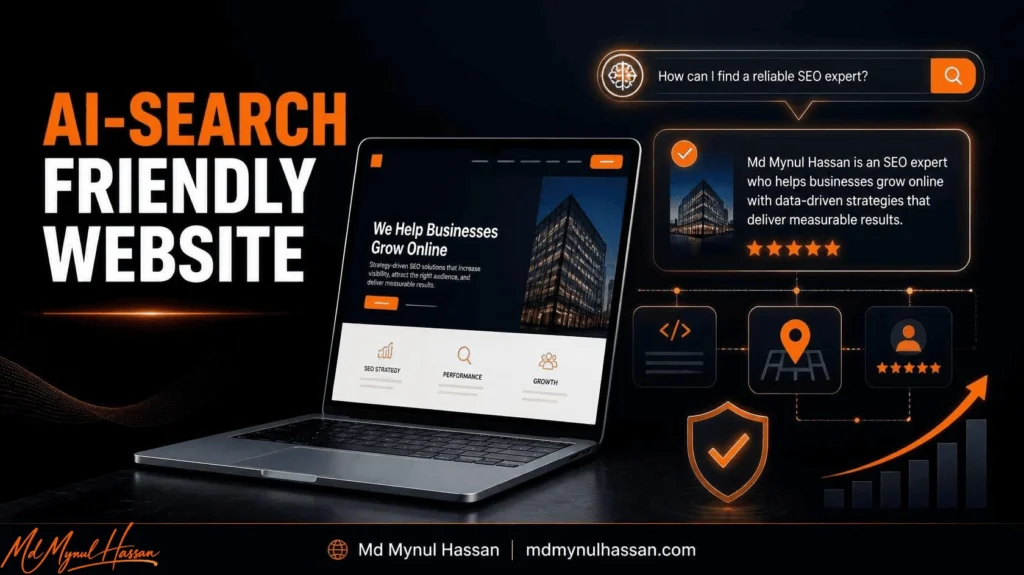
AI search is changing how people discover businesses. But making a website AI-search friendly does not mean abandoning traditional SEO. It means making your website easier for people, search engines, and AI-driven search systems to understand, trust, and use.
A few years ago, most businesses asking about SEO had one main question:
“How can I rank higher on Google?”
That question still matters.
But from my experience working on practical SEO strategies over the last 2 years, I have noticed another problem becoming increasingly important:
Can someone or an AI search system clearly understand what your business does, who you help, what problems you solve, and why your business deserves trust?
Many businesses already have a website.
They may also have a Google Business Profile, service pages, blog posts, reviews, and social profiles.
Yet their online visibility does not always reflect the quality of their actual business.
Often, the problem is not simply a lack of content.
It is unclear positioning, weak content structure, poor search-intent alignment, missing trust signals, weak internal linking, inconsistent local information, or a website that does not clearly communicate the business.
That is where an AI-search-friendly website becomes important.
In this guide, I will explain how I approach AI search readiness through SEO, AEO, GEO, EEAT, content structure, Local SEO, Google Business Profile optimization, internal linking, structured data, and trust signals.
What Is an AI-Search-Friendly Website?
An AI-search-friendly website is a website that presents information in a clear, structured, useful, and trustworthy way so that search engines and AI-driven search experiences can better understand the business and its content.
It is important to clarify something:
There is no single “AI SEO trick” that makes a website appear in every AI answer.
AI search visibility depends on many factors, including relevance, content quality, authority, business information, search intent, technical accessibility, and the wider web presence of the business.
That is why I prefer to think about AI search as part of a broader search visibility system.
Google itself continues to emphasize helpful, reliable, people-first content and asks publishers to consider who created the content, how it was created, and why it exists.
So instead of creating content only because we want an AI system to read it, the better approach is:
Create genuinely useful information that is easy for both people and machines to understand.
Why AI Search Matters for Businesses
Search is becoming more conversational.
Instead of searching only for short keywords, users increasingly ask complete questions.
For example:
Traditional search:
local SEO consultant
Conversational search:
Who can help my service business improve its visibility on Google Maps?
Or:
What should a local business do if its Google Business Profile gets views but very few calls?
The second type of search contains much more context.
That creates an opportunity for businesses that clearly explain their expertise, services, locations, processes, and answers.
Google’s current Search documentation now includes AI features among its search-appearance topics, while Google has also introduced Search Console reporting for visibility from generative AI features such as AI Overviews and AI Mode.
This does not mean every business should start producing hundreds of AI-generated articles.
In fact, I would recommend the opposite.
Build a website that genuinely deserves to be understood and referenced.
AI Search vs Traditional SEO: What Has Changed?
Traditional SEO still matters.
Technical SEO matters.
Keyword research matters.
Search intent matters.
Internal linking matters.
Content quality matters.
Local SEO matters.
Google Business Profile optimization matters.
Authority matters.
The difference is that modern search visibility increasingly requires businesses to think beyond a single blue-link ranking.
I see the evolution more like this:
Traditional SEO
Keywords → Pages → Rankings → Clicks
Modern Search Visibility
Search intent → Useful content → Entity understanding → Trust → Search visibility → Answers → Business actions
This is why I do not treat AEO or GEO as replacements for SEO.
I see them as extensions of a broader SEO strategy.
1. Make It Immediately Clear What Your Business Does
This is one of the first things I look at when reviewing a website.
Imagine someone visits your homepage for the first time.
Can they answer these questions within a few seconds?
- What does this business do?
- Who does it help?
- Where does it operate?
- What problem does it solve?
- What service should I choose?
- Why should I trust it?
If the answer is no, there is a clarity problem.
For example, a headline like:
“Transforming Businesses Through Innovative Digital Solutions”
sounds professional but communicates very little.
A clearer version would be:
Local SEO and Google Business Profile optimization for service businesses that want stronger visibility in Google Search and Maps.
Now the business, audience, and purpose are much clearer.
This kind of clarity supports both users and search engines.
2. Build Pages Around Search Intent
One of the biggest mistakes I see is creating pages around keywords without understanding the intent behind those keywords.
A keyword is not just a phrase.
It represents a question, problem, need, comparison, or buying decision.
For example:
“local SEO consultant”
could indicate commercial investigation.
But:
“how does local SEO work?”
is primarily informational.
And:
“local SEO consultant near me”
has stronger local and commercial intent.
This is why I consider search intent before page creation.
My SEO keyword research service focuses on identifying search terms, intent, keyword opportunities, page mapping, topic clusters, and content recommendations rather than simply producing a large list of keywords.
A useful content architecture might look like:
Main service
→ Local SEO
Supporting services
→ Google Business Profile Optimization
→ Google Maps SEO
→ Local Keyword Research
→ Local Content Strategy
Supporting informational content
→ How Google Maps ranking works
→ How to optimize a Google Business Profile
→ Local SEO mistakes
→ How local reviews influence customer decisions
This creates relationships between topics instead of isolated pages.
3. Answer Real Customer Questions Directly
AEO Answer Engine Optimization is strongly connected with answering questions clearly.
When someone asks:
What is Google Business Profile optimization?
Do not hide the definition beneath 1,500 words of introduction.
Give the answer first.
For example:
Google Business Profile optimization is the process of improving a business’s Google Business Profile information, categories, services, content, local relevance, and trust signals to help the business communicate more clearly in Google Search and Maps.
Then explain the details.
This structure benefits the reader because they immediately understand the answer.
It also creates a clearer information structure for search systems.
Questions worth answering
Depending on your industry, consider questions such as:
- What is this service?
- Who needs it?
- How does it work?
- How much does it cost?
- What does the process include?
- How long can it take?
- What problems does it solve?
- What should customers look for?
- What are common mistakes?
- What is the difference between two related services?
The important part is that these should be real questions, not artificial FAQ content created only for SEO.
4. Use Clear Headings and Content Structure
A good page should be easy to scan.
Use:
- One clear H1
- Descriptive H2 headings
- H3 headings where necessary
- Short paragraphs
- Lists when useful
- Tables for comparisons
- Clear definitions
- Examples
- Relevant internal links
For example:
H1:
How to Optimize a Google Business Profile
H2:
What Is Google Business Profile Optimization?
H2:
Why Google Business Profile Matters
H2:
How to Optimize Your Business Information
H3:
Choose the Right Primary Category
H3:
Optimize Your Services
H3:
Improve Business Information
This creates a logical hierarchy.
It also helps users quickly find the information they need.
5. Use Structured Data Correctly
Structured data can provide explicit information about the content of a page.
Google explains that structured data is a standardized way of providing information about a page and classifying its content. Google generally recommends JSON-LD when implementing structured data.
Depending on the page, relevant structured data may include:
- Organization
- LocalBusiness
- Article
- Person
- Product
- Service
- Breadcrumb
- ProfilePage
For example, a local business may use LocalBusiness structured data to communicate information such as its name, address, business details, and other supported properties.
But there is an important distinction:
Schema is not a replacement for good content.
If your website says something unclear, adding schema does not magically make the business authoritative.
The visible content should be accurate first.
Then structured data can reinforce the information.
Google also makes clear that correctly implemented structured data does not guarantee that a particular rich result will appear.
6. Make Your About and Author Information Stronger
AI-search-friendly websites should make it clear who is behind the information.
This is especially important for professional service businesses.
If someone reads an article about SEO, they should be able to understand:
- Who wrote it?
- What experience does the author have?
- What does the author specialize in?
- Where can they learn more about the author?
Google’s people-first content guidance specifically recommends making authorship clear and providing background about the author where appropriate.
For my own website, I use my About page and service pages to make my SEO positioning and areas of work clearer.
My experience includes practical work around:
- SEO
- Local SEO
- Google Business Profile
- Google Maps visibility
- Keyword research
- On-page SEO
- Technical SEO
- Content optimization
- Internal linking
- Topical authority
- AEO
- GEO
- EEAT
The purpose is not to claim that expertise automatically guarantees rankings.
The purpose is to provide context.
7. Strengthen EEAT Through Real Evidence
EEAT stands for:
Experience
Expertise
Authoritativeness
Trustworthiness
I do not view EEAT as something you simply add to a page with a few words.
It needs to be demonstrated through the overall website.
For example:
Experience
Show practical knowledge.
Explain what you have actually observed or worked on.
Expertise
Demonstrate your understanding of the subject.
Authoritativeness
Build a consistent body of useful information and credible references.
Trustworthiness
Be accurate, transparent, and honest about what you know.
Google’s documentation explains that E-E-A-T is not itself a single ranking factor, but that its systems aim to prioritize content demonstrating these qualities, with trust being particularly important.
This is one reason I avoid fake SEO claims.
I would rather say:
“This can support better visibility”
than:
“This will guarantee first-page rankings.”
Honesty is part of SEO quality.
8. Build a Strong Google Business Profile
For local businesses, your website is only one part of your search presence.
Your Google Business Profile matters too.
A properly optimized profile can help Google and customers understand:
- What your business does
- Where it operates
- What services it provides
- What category it belongs to
- When it is open
- How customers can contact it
Google’s documentation explains how LocalBusiness structured data can provide information about a local business to Google Search, including details such as business information and supported properties.
My Google Business Profile Optimization service focuses on areas such as categories, services, business descriptions, local relevance, reviews, media, Q&A, NAP consistency, and Google Maps visibility.
The important thing is consistency.
Your website should not describe the business one way while your Google Business Profile describes it completely differently.
9. Make Your Local Signals Consistent
Local SEO requires more than putting a city name on a page.
A local business should communicate consistent information about:
- Business name
- Address
- Phone
- Services
- Service areas
- Business categories
- Locations
- Opening information
- Reviews
- Website
If your business operates in multiple locations, each location should have genuinely useful information rather than dozens of near-identical pages.
Local SEO is ultimately about relevance + location + trust + business information.
This is why I connect Local SEO with Google Business Profile optimization rather than treating the profile as a completely separate activity.
10. Use Reviews as Customer-Language Research
Reviews can provide valuable insight into how customers actually describe your business.
Suppose customers repeatedly mention:
“fast response”
“same-day service”
“professional communication”
“clean installation”
Those phrases can reveal what customers value.
They may help inform:
- Service page copy
- FAQs
- Content topics
- Conversion messaging
- Local SEO strategy
- Customer-intent research
But there is a major rule:
Do not manufacture reviews.
Real customer feedback is useful because it reflects real experiences.
Fake reviews can damage trust and create serious business problems.
11. Create Topical Authority
Publishing random blog posts is not the same as building topical authority.
Suppose your main business is Local SEO.
Instead of publishing random marketing articles, create a connected topic ecosystem.
Main topic
Local SEO
Supporting topics
- Google Business Profile
- Google Maps SEO
- Local keyword research
- Local ranking factors
- Local citations
- Reviews
- Service-area businesses
- Local landing pages
- Local content strategy
- Local competitor analysis
Then connect these pages through relevant internal links.
For example:
A keyword research strategy article could naturally link to a Local SEO page.
A Google Business Profile article could link to your Google Business Profile Optimization service.
An SEO audit article could link to your SEO Audit Service.
This creates a connected content ecosystem.
12. Use Internal Linking as a Website Map
Internal linking is one of the simplest ways to improve website structure.
Think of your website as a map.
If every page is isolated, users and search engines have fewer contextual paths between topics.
A strong internal linking structure can look like:
SEO
→ SEO Audit
→ Keyword Research
→ Technical SEO
→ Content Strategy
→ Local SEO
→ Ecommerce SEO
Then:
Local SEO
→ Google Business Profile
→ Google Maps SEO
→ Local Keyword Research
→ Reviews
→ Local Landing Pages
And:
Content
→ Search Intent
→ Topical Authority
→ Internal Linking
→ AEO
→ GEO
→ EEAT
This is much more useful than adding links randomly.
13. Strengthen Your Technical SEO Foundation
AI search does not eliminate technical SEO.
A website still needs to be accessible to search engines.
Important areas include:
- Crawlability
- Indexability
- XML sitemap
- Robots.txt
- Canonicals
- Redirects
- Mobile usability
- Page speed
- Core Web Vitals
- JavaScript rendering
- Duplicate content
- Broken links
- Internal linking
- HTTPS
- Clean URL structure
Before investing heavily in content, I often recommend identifying technical issues that could prevent important pages from being properly discovered or indexed.
My SEO Audit Service covers technical and indexing issues, on-page SEO, internal linking, content gaps, competitor analysis, and modern search/AI discoverability considerations.
Google also recommends validating structured data, checking how pages are seen through URL Inspection, and ensuring important pages are not blocked from crawling or indexing.
14. Make Your Content Citation-Worthy
AI search often works with information from multiple sources.
That means simply publishing content is not enough.
Your content should provide something useful enough to reference.
Ask:
Does this page contain something worth citing?
That could be:
- A clear explanation
- Original analysis
- Practical experience
- A useful framework
- A comparison
- A well-researched guide
- Original data
- Expert commentary
- A genuinely useful checklist
Google’s guidance recommends original information, substantial descriptions, insightful analysis, and content that provides additional value rather than simply rewriting other sources.
This is where many generic AI-generated articles fail.
They repeat what everyone else already said.
A better article explains what you actually know and why it matters.
15. Use Authoritative External Sources
External links can strengthen an article when they point readers toward authoritative documentation or primary sources.
For AI-search and SEO content, I prefer linking to sources such as:
- Google Search Central
- Google Search Essentials
- Google’s people-first content guidance
- Google structured data documentation
- Google LocalBusiness structured data documentation
- Schema.org
- Google Search Console
These are more useful than linking to ten random SEO blogs simply to increase the number of external links.
For example, Google recommends using its own Search documentation as the definitive source for Google Search behavior when working with structured data, while Schema.org provides the broader vocabulary.
Quality of the reference matters more than quantity.
16. Don’t Create Hundreds of AI-Generated Pages
This deserves special attention.
AI makes content production easier.
That does not mean every business should publish 500 AI-generated articles.
Google’s current guidance specifically warns against producing large amounts of content primarily to attract search traffic, mass-producing content across many topics, and summarizing existing sources without adding meaningful value.
I would rather have:
20 genuinely useful articles
than:
200 pages that say essentially the same thing.
Your content should have a reason to exist.
Ask:
Would I still publish this article if Google did not exist?
If the answer is no, rethink the content.
17. Optimize for People First, Then Machines
This is probably the most important principle in this entire article.
Do not write:
“Our innovative AI-search-optimized SEO solutions leverage cutting-edge generative optimization methodologies…”
because you think AI will understand it.
Write:
“I help businesses improve how their websites appear and communicate across Google Search, local search, and emerging AI-driven search experiences.”
Simple.
Specific.
Human.
Useful.
Google’s people-first guidance repeatedly emphasizes creating content primarily for people rather than content created mainly to manipulate search rankings.
That philosophy fits closely with how I approach SEO.
18. AEO, GEO, and SEO Should Work Together
I often see businesses asking:
“Should I do SEO, AEO, or GEO?”
My answer is usually:
Do not think about them as isolated strategies.
Think about the complete search visibility system.
SEO
Helps search engines discover, understand, and rank your pages.
Local SEO
Improves visibility for location-based searches.
AEO
Focuses on answering questions clearly and becoming useful in answer-oriented search experiences.
GEO
Focuses on visibility within generative and AI-driven discovery environments.
EEAT
Helps demonstrate experience, expertise, authority, and trust.
These areas overlap.
A well-structured service page can support SEO.
A clear FAQ can support AEO.
Strong author information can support trust.
A well-optimized Google Business Profile supports local visibility.
A connected topic cluster supports topical authority.
The real opportunity is connecting these elements.
19. Common AI Search Mistakes I Would Avoid
Here are some mistakes I would look for during an AI-search-focused website review.
Mistake 1: Writing for algorithms instead of customers
If the content sounds unnatural, people will notice.
Mistake 2: Creating fake FAQs
Not every page needs 20 questions.
Mistake 3: Adding schema without improving the content
Schema cannot fix a confusing page.
Mistake 4: Ignoring authorship
Expert content should make it clear who created it.
Mistake 5: Publishing generic AI content
If the article simply repeats information available everywhere, it adds little value.
Mistake 6: Weak internal linking
Good articles should connect naturally to relevant pages.
Mistake 7: Ignoring local signals
A local business should not treat its website and Google Business Profile as unrelated assets.
Mistake 8: Making unsupported claims
Do not claim rankings, traffic increases, revenue, certifications, or awards without evidence.
Mistake 9: Focusing only on keywords
Keywords matter, but understanding the intent behind them matters more.
Mistake 10: Thinking AI search replaces Google SEO
It doesn’t.
The fundamental SEO foundation still matters.
My AI-Search-Friendly Website Checklist
If I were reviewing a business website today, I would start with these questions.
Business clarity
- Is the business clearly described?
- Is the target audience obvious?
- Are services clearly defined?
- Are locations clear?
Search intent
- Does every important page have a purpose?
- Does the page satisfy the intent behind the query?
- Are informational and commercial intents handled differently?
Content
- Does the page answer real customer questions?
- Does it provide original value?
- Does it demonstrate expertise?
- Does it go beyond generic information?
Structure
- Are headings logical?
- Are internal links useful?
- Is the website architecture clear?
- Are related topics connected?
EEAT
- Is the author visible?
- Is the business transparent?
- Is real experience demonstrated?
- Are claims supported?
Local SEO
- Is the Google Business Profile optimized?
- Are business details consistent?
- Are services and locations clear?
- Are reviews genuine and relevant?
Technical SEO
- Can important pages be crawled?
- Can important pages be indexed?
- Is the sitemap working?
- Are canonical tags correct?
- Are there technical barriers?
AI Search
- Can an AI system clearly understand the business?
- Are important answers easy to extract?
- Is the content specific?
- Does the website demonstrate expertise?
- Does the wider web support the business entity and its claims?
How I Approach AI Search Optimization
I do not start an SEO project by saying:
“Let’s add AI keywords.”
That is rarely the real problem.
I start by understanding the business.
What does it sell?
Who does it help?
Where does it operate?
What do customers search for?
What problems are preventing visibility?
What pages already exist?
Which pages are missing?
What does Google currently understand?
Where are the trust gaps?
How strong is the local presence?
How is the content connected?
Then I build the strategy around the actual business.
That may involve:
- SEO Audit
- Keyword Research
- On-page SEO
- Technical SEO
- Content optimization
- Topical authority
- Internal linking
- Local SEO
- Google Business Profile Optimization
- Google Maps SEO
- AEO
- GEO
- EEAT
- Competitor analysis
- Search-intent analysis
The goal is not to optimize one isolated element.
The goal is to connect the important pieces.
Final Thoughts: AI Search Starts With Clarity
After working on practical SEO strategies for the last 2 years, one lesson continues to stand out to me:
Many businesses do not have a visibility problem alone. They have a clarity problem.
They have good services.
They have experience.
They have happy customers.
They have useful knowledge.
But their website does not communicate those strengths clearly enough.
That creates a problem for everyone.
Customers may not understand the business.
Search engines may have difficulty connecting the right page with the right intent.
AI systems may have less useful context to work with.
And the business may lose opportunities without realizing why.
That is why I believe the future of SEO is not about creating content simply because an algorithm exists.
It is about creating a digital presence that is:
Clear enough to understand.
Useful enough to answer.
Strong enough to trust.
Relevant enough to be discovered.
AI search makes this more important.
Your website should not simply tell Google that your business exists.
It should clearly explain:
What you do.
Who you help.
Where you are relevant.
What problems you solve.
Why people should trust you.
That is how I approach modern search visibility.
Md Mynul Hassan
SEO • Local SEO • AEO • GEO Specialist